The hard part is not sounding human — it is getting time zones, languages, order state and returns policy right at the same time
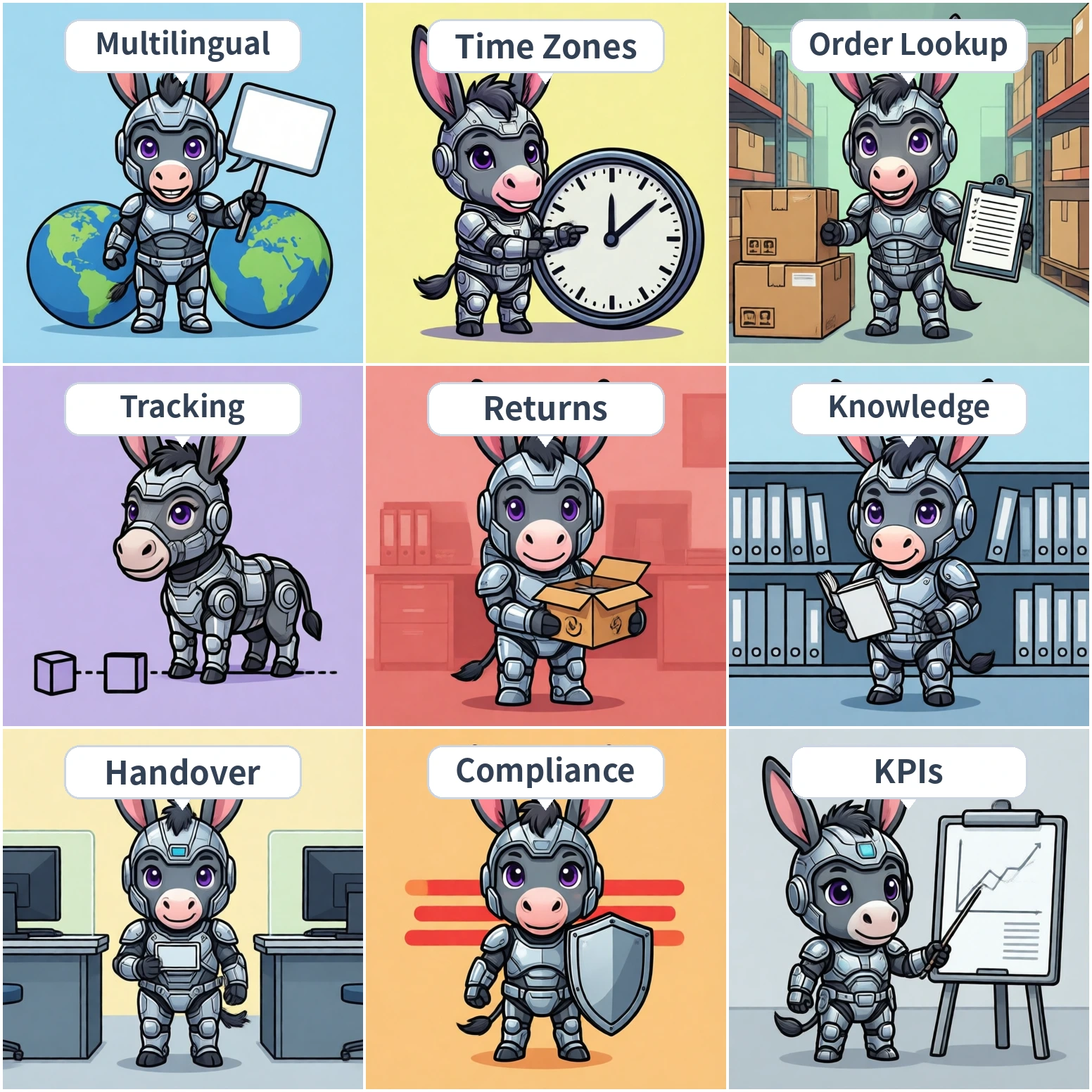
Many teams treat cross-border support as "domestic support plus translation". In practice, four difficulties stack on top of each other:
| Difference | What it looks like | What it demands from an AI agent |
|---|---|---|
| Language | Same catalog, same policy, expressed in many languages | Answers must be rewritten per language, not sentence-by-sentence translated |
| Time zones | Customers ask during their day, your team sleeps | Either fully automated coverage, or an explicit response-time promise |
| Orders and logistics | State is spread across platform, carrier and warehouse systems | Must read real state, never guess |
| Policy and compliance | Returns, duties and privacy rules differ per market | Every answer needs a source; out-of-scope questions must be refused |
This is why the first question is not "does it sound human" but "is the information true, and is it true for this market". A wrong answer costs more here than domestically — return shipping, dispute rates and marketplace penalties are all less forgiving.
The most common failure is machine-translating a Chinese (or English) FAQ into ten languages and shipping it. Grammar is fine, tone is not, and customers can tell it was translated — trust drops immediately.
| Approach | Upside | Cost |
|---|---|---|
| One source language + machine translation | Lowest maintenance | Stiff tone, terminology errors, poor experience |
| Independently maintained per language | Natural and accurate | Maintenance multiplies; versions drift apart |
| Source master + human review per language | Balanced: structure stays in sync, wording is local | One-time review effort, then sync on change |
Take the third path: keep one structural master (Chinese or English), have a native speaker review each target language once, then only update the diffs when policy changes. The acceptance test is simple — if a native reader can point at a sentence and say "this reads like a translation", it is not done.
Also plan for language detection and switching. Customers may write in a language you do not support, or mix two. The correct behaviour is to state which languages are supported and offer a human handover — not to guess and answer anyway.
This is the one part that cannot be solved by a knowledge base. Order state, tracking events and customs progress are live data; they must come from an API, never from a static FAQ entry.
List your data sources first: which fields the marketplace order API returns, which events the carrier exposes, whether the warehouse system can return stock. Teams often design the conversation flow first and only then discover there is no customs-progress API — in which case that part can only offer "estimated timeline plus human handover", never a fake lookup.
Order lookups must verify identity (order number plus email or phone suffix). Without it, anyone can pull anyone's order details. This is a security floor, not a UX nicety. On failure, return one uniform message — never "is the order number correct?", which can be enumerated.
Timeouts, missing orders and abnormal states all need explicit wording and a handover. The dangerous behaviour is inferring a plausible state from a similar order — a customer acting on a wrong "already shipped" status is far worse than "let me have a human verify this for you".
The essence of this workstream: treat the agent as an assistant that calls tools, not as a search box that talks. Tool boundaries, failure handling and permission checks are engineering problems, not prompt problems.
Returns are where disputes concentrate, and where an AI is most likely to "helpfully" get it wrong. Models readily generalise "7-day return window" into "everything is returnable", and "unused condition" into "opened is fine".
Encode policy as structured rules judged by code; the model only explains the outcome:
# Illustrative rules — use your own policy fields and thresholds
Conditions:
  1. Within the return window (delivery date + policy days)
  2. Category is not on the non-returnable list (custom, perishable, hygiene items)
  3. Unopened / resaleable condition
  4. Quality issue or not (determines who pays shipping)
Output:
  - returnable / not returnable / needs human review
  - who pays shipping
  - next step for the customer (with entry point)
Key point: keep rule evaluation and wording generation separate. Code decides; the model phrases it in the customer's language. Policy changes then mean editing a rule table, not retraining or rewriting prompts — and the model cannot invent an out-of-policy promise.
A cross-border team cannot be online 24/7. Covering the empty hours is one of the main values of an AI agent, but only if the boundary is explicit:
| Window | What the agent does | Wording |
|---|---|---|
| Staffed | Routine Q&A and lookups, hand over complex cases | Answer normally; on handover, state expected wait |
| Unstaffed | Routine Q&A, lookups, open a ticket | Say clearly "a human will reply within X hours" — never imply someone is waiting |
| Peak / incident | Prioritise high-frequency questions, proactively flag delays | Prepare canned wording for shipping delays and stock issues |
One easily missed detail: express the expected response time in the customer's time zone, not yours. "We will reply within 8 hours" is more useful than an internal clock reference.
How good an AI agent is depends heavily on when it is willing to let go. Write the handover triggers explicitly rather than leaving them to the model:
① The customer asks for a human; ② money disputes, complaints, legal or privacy matters; ③ two consecutive unresolved turns or visible frustration; ④ tool failure (order or tracking lookup failed).
Pass a conversation summary, the order information already retrieved, the customer's language and time zone. A handover without context forces the customer to repeat everything — worse than no handover at all.
Once a human takes over, the agent must stop replying. It sounds trivial, but it is one of the most common complaints — the bot keeps answering while a person is already typing.
| Rule | How | What breaks without it |
|---|---|---|
| Partition by market | Keep policy, timelines and duty notes per market separately | Market A's policy gets answered to a market B customer — immediate dispute |
| Record source and effective date | Every policy entry carries its origin and date | Policy changed, knowledge base did not — you answer with the old rule |
| Separate facts from advice | Facts (timelines, policy) quoted verbatim; advice (size guidance) may be phrased flexibly | Advice gets treated as a factual promise |
For retrieval mechanics (chunking, hybrid search, permission isolation), see AI Agent knowledge base pitfalls. The cross-border addition is the market partition layer on top of it.
"Guaranteed delivery in X days" or "you can definitely return it" will be quoted back to you when a shipment slips or a policy changes. Say "usually X days" and "returnable if the conditions are met; see policy".
Duties, customs clearance, invoicing and compliance filings are professional territory. Explain the process and required documents; route amounts and liability to a human or an official channel.
Never echo full addresses, full phone numbers or payment details. Confirm using masked values only — this is also a data-protection requirement in many markets.
| # | Check | Criterion |
|---|---|---|
| 1 | Multilingual quality | 20 real questions per language; a native speaker judges "does not read like a translation" |
| 2 | Order lookup verification | Wrong credentials return no order data, and the response cannot be enumerated |
| 3 | Lookup failure handling | 100% handover on API failure or missing order; no inferred status |
| 4 | Returns rule consistency | Rule engine output sampled against human judgement; no systematic bias |
| 5 | Handover triggers | All four mandatory cases tested and hit |
| 6 | Handover context | Human side sees summary + retrieved data + language and time zone |
| 7 | Unstaffed wording | Response time expressed in the customer's time zone, no internal clock references |
| 8 | Compliance scan | Grep all wording for promises, tax/legal advice and personal-data echoes — zero hits |
Add a native-reader review gate. If it fails, rewrite per language instead of hoping the model becomes idiomatic.
Hand over when the API fails. One extra "let me verify" beats a confident wrong status.
Encode it as a rule table judged by code; the model only phrases the result.
Partition by market and filter by market at retrieval time. This is the biggest structural difference from domestic-only support.
Attach a summary and the data already retrieved, so the customer does not repeat themselves.
State "a human will reply within X hours" in the customer's time zone. Do not let them wait for a person who is not there.
The build order that works: wire up order and shipment lookups first (you can only answer safely with real data) → then encode returns rules (lock down the most error-prone part) → then build the multilingual knowledge base (it sets the experience ceiling) → finally tune time zones and handover (it sets the safety floor). Doing it the other way round — chasing "sounds human" before you have data sources — usually collapses at the first failed order lookup.
If your support team already runs on several messaging platforms (for example WeCom or DingTalk domestically and WhatsApp or Telegram overseas), solve "one console for all channels" before adding AI capability — otherwise every new channel means redoing the logic. For the architecture, see connecting an AI agent to messaging platforms.