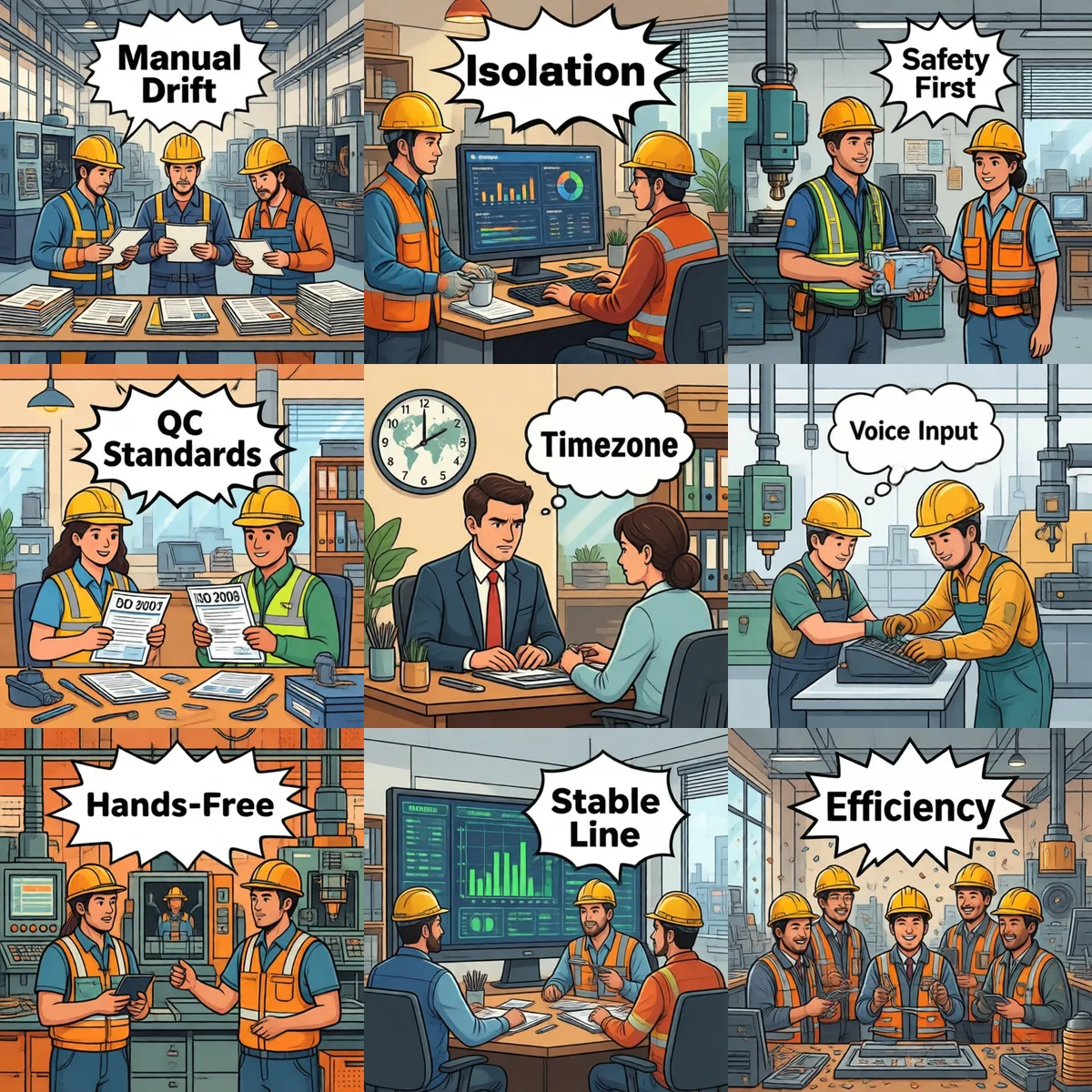
TL;DR — Manufacturing AI hits six pitfalls: workshop manual version drift (50 machines across 3 models in one plant), cross-plant data isolation, safety disclaimers (AI cannot give "this is safe" verdicts), QA standard differences (ISO 9001:2015 vs 2008), supply-chain timezone (overseas suppliers 5pm), and floor-worker usability (gloves / glare / literacy). First three are safety + compliance; last three are experience.
1. Workshop manual version drift: 50 machines across 3 models
Pitfall: worker asks "what does alarm code E03 mean?" — AI returns Model A's manual, Model B is completely different
Manufacturing shop manuals have three quirks: (1) many equipment models (one shop may run 5–10); (2) each model's manual is maintained independently with its own update cadence; (3) older equipment manuals may go 5–10 years without updates. If the AI KB isn't strictly indexed by "model × manual version", one wrong answer can cause a safety incident — worker follows the wrong procedure, machine crashes or injures a hand.
✅ Fix: (1) KB indexed by three dimensions: "model + manual version + equipment serial" — AI must ask which machine before answering. (2) Workers scan a QR code (mounted on each machine) when entering the AI session — AI auto-locates model + manual version. (3) Older equipment manuals reviewed at least yearly; expired versions aren't deleted, just flagged — old machines still need old manuals for repair.
2. Cross-plant data isolation: Suzhou plant sees Shenzhen orders
Pitfall: Suzhou scheduler asks "Customer A order scheduling this month" — AI returns Shenzhen plant's schedule (different prices / quantities)
Manufacturing "multi-plant" is a trade secret: (1) different plants serve different customer segments; (2) pricing / cost / capacity are commercial secrets; (3) Plant A scheduler seeing Plant B's data = customer cross-orders + price leakage. If AI allows cross-plant search by "order type", that's effectively making the group's entire commercial structure public.
✅ Fix: (1) Three-dimensional permission matrix: plant × role × tools. Suzhou scheduler → ["own plant orders", "own plant capacity"]; group scheduler → ["group statistics"]; CEO → ["all"]. (2) Any cross-plant query must leave an audit log — cross-order risk is traceable. (3) "Group statistics" returns only "numbers", never client names / order details.
3. Safety: AI cannot give "this is safe" verdicts
Pitfall: worker asks "what happens if I touch this 220V directly?" — AI answers "generally fine"
The most dangerous thing about a manufacturing AI assistant is its "authority" — workers trust AI as expert, AI gives "safety guarantees" and an incident occurs. Legally AI is not a "safety engineer"; its "generally fine" becomes "direct liability" at the accident scene.
✅ Fix: (1) AI reply template forces a "safety disclaimer": "this answer is reference only, final word is the on-site safety engineer / operating manual". (2) Four safety categories — voltage / high-temperature / chemicals / work-at-height — AI defaults to escalate to human. (3) The AI service deployed on the floor works offline (cached manuals), doesn't depend on the cloud — network failure shouldn't drive workers to "just do it".
4. QA standard differences: Plant A ISO 9001:2015, Plant B ISO 9001:2008
Pitfall: QC inspector asks "client complains 0.05mm size deviation — is it within ISO?" — AI returns ISO 9001:2015; Plant B still uses ISO 9001:2008 where 0.1mm is the threshold
Manufacturing "standard variance" is where AI assistants trip the most: (1) different plants may use different ISO years; (2) different customers have customer-supplied standards (often stricter than ISO); (3) export customers require destination-country standards (CE / UL / CCC). Wrong standard from AI = returns / fines.
✅ Fix: (1) KB managed by four dimensions: "standard type × standard version × applicable plant × applicable customer". (2) AI must ask "which standard? which customer?" before answering. (3) Inspection results double-confirmed: AI gives reference + veteran inspector signs off — AI never directly judges pass / fail.
5. Supply-chain timezone: overseas suppliers 5pm close
Pitfall: urgent material shortage — domestic procurement at 9am messages German supplier; they're already off at 5pm local
Manufacturing "globalized supply chain" is normal: (1) overseas suppliers in many timezones; (2) overlap working windows are short; (3) urgent shortages don't wait. AI assistant scheduled by server time misses the golden contact window.
✅ Fix: (1) AI service reads each supplier's local timezone + working hours, scheduled messages send by their local time. (2) Urgent contacts go SMS / WhatsApp / DingTalk International first (not bound by working hours), email as fallback. (3) Critical-path overseas suppliers have a domestic backup — 4-hour recovery if overseas goes silent.
Pitfall: worker in gloves asks phone "Machine #X2 alarm code" — 70% typos, AI can't understand at all
On the manufacturing floor, "keyboard input" is anti-human: (1) workers wear gloves (can't do fine motor actions); (2) strong shop light, screen glare unreadable; (3) wide literacy variance. AI assistant designed around "text chat" won't be used on the floor at all.
✅ Fix: (1) AI assistant defaults to voice input, supports regional accents (Cantonese / Hokkien / Mandarin). (2) Key questions support photo capture (snap machine alarm light / snap part defect), AI vision + give operating guidance. (3) Floor deploys industrial large screen + one-button help — press to connect directly to on-site engineer, bypass typing entirely.
SOP: 90 days to a working manufacturing AI
W1–2: Equipment × manual version three-dimensional index — this comes first, not the KB.
🤝 Manufacturer thinking about AI? These 6 SOPs are the floor — how much more depends on your scale.
📧 278946228@qq.com — usually a reply within 24 hours.
Running these problems at work?
One console for Feishu / WeCom / DingTalk / Weixin / QQ — policies on demand, no more chasing colleagues