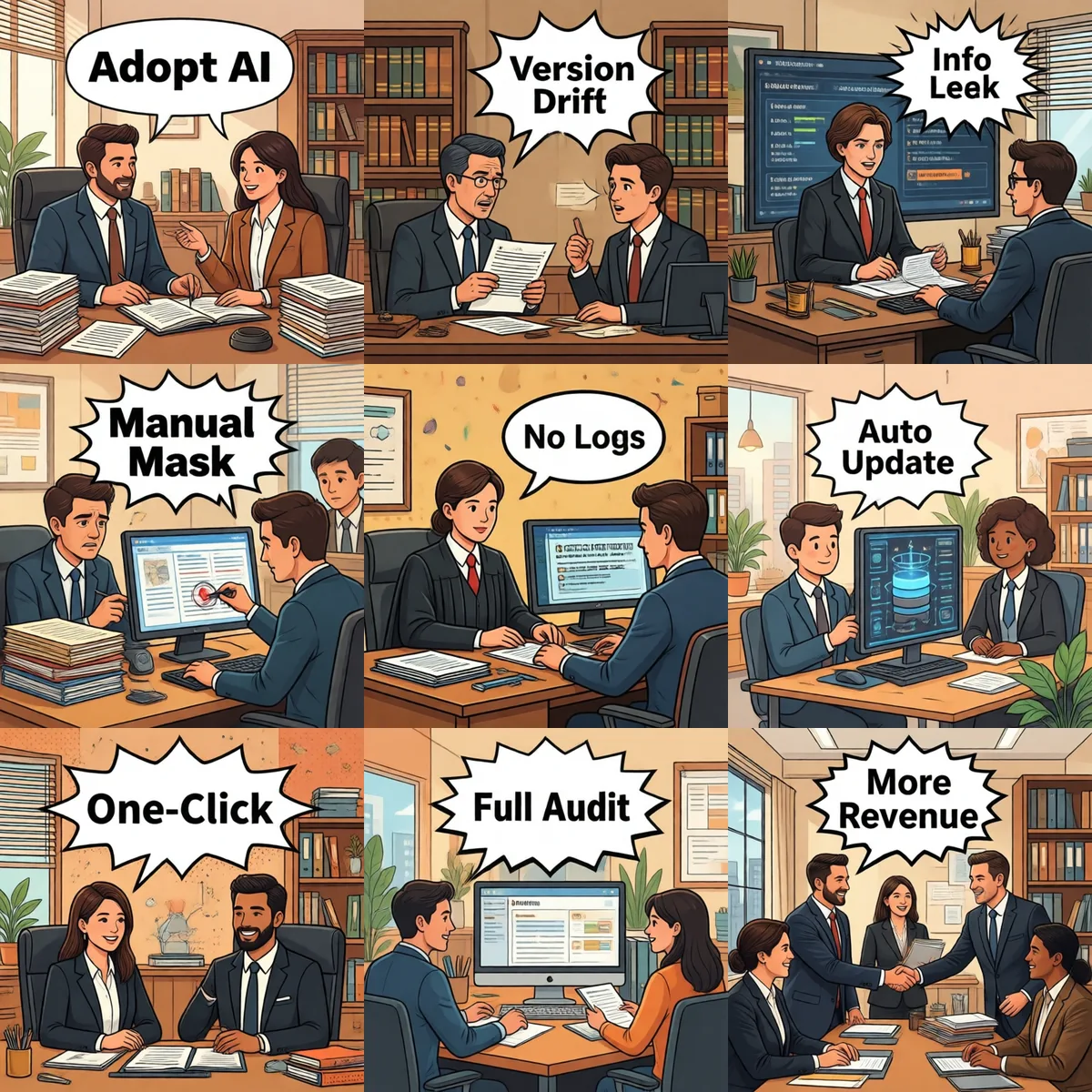
Statute versions · Case redaction · Multi-jurisdiction confusion · AI cannot practice law · Hours / billing · Client file isolation
2026-07-15 · Leo · 11 min read
TL;DR — Law firm / in-house legal AI hits six pitfalls: statute version drift (Civil Code 2020, but judicial interpretations update yearly), case-database client redaction, multi-jurisdiction confusion (US case law bleeding into China questions), AI cannot practice law (compliance line), hours/billing miscalc, client file isolation (partner A peeking at partner B's clients). First three are compliance floors; last three are operational.
1. Statute version drift: code 2020, but interpretations update yearly
Pitfall: lawyer asks "what does Civil Code Article 1064 say?" — AI returns the 2020 original text, no citation of the 2024 judicial interpretation
China's legal system has a "two-layer" structure: (1) the statute itself (e.g. Civil Code) typically gets a major revision every 5–10 years; (2) judicial interpretations / guiding cases / conference minutes update almost yearly; (3) provincial high court "rules of decision" are even denser. If the AI KB only updates the statute itself, lawyers get old-calendar answers — write an opinion based on that, the client may lose the case.
✅ Fix: (1) KB managed in three layers: "statute + judicial interpretation + guiding case", each tagged with issue date / amendment date / expiry date. (2) AI answers must carry a "knowledge cutoff" ("answer based on 2026-07 interpretations"). (3) Legal ops reviews Supreme Court + provincial courts weekly, updates KB + marks expired answers.
2. Case database client redaction: case A's details in case B's search
Pitfall: lawyer asks "similar equity dispute cases" — AI returns a case that implicitly contains firm A's client name + amount
A law firm case database has three special properties: (1) client name / ID / bank account are highly sensitive; (2) case details are trade secrets (settlement amount / equity ratio); (3) within one firm, different partners' cases are mutually invisible. If AI's "case search" becomes "cross-case full-text search", a common query leaks multiple cases' information.
✅ Fix: (1) Hard-redact on intake (client name → "Party A/B/C", ID → "ID_xxxx", amount → "[amount]"), AI only returns the redacted version. (2) RAG results filtered by "current user permission" — junior lawyers can't see senior partners' cases. (3) Client files never contain other cases' details — only "case type / firm role / timeframe".
3. Multi-jurisdiction confusion: China lawyer asks "China law" — AI cites US case
Pitfall: lawyer asks "Chinese VAM (valuation adjustment mechanism) case law" — AI returns a Delaware Court decision as reference
In LLM training data, Chinese law is a small slice (< 5%); US case law is the bulk. If RAG search slips, AI may quote "US / HK / Singapore" cases when answering China law questions — misleading at best, disastrous at worst.
✅ Fix: (1) KB strictly layered by "jurisdiction" (China / US / HK / international arbitration / other), AI search filtered by the user's jurisdiction. (2) Every answer must tag jurisdiction + year ("China Supreme People's Court 2024 judicial interpretation"). (3) Any answer without jurisdiction tag is judged "unusable", returned to human.
4. AI cannot practice law: compliance line + disclaimers
Pitfall: client asks AI directly "will I win my case?" — AI replies "70% chance of winning"
Under most jurisdictions, AI cannot give legal advice. If the AI gives clients "winning probability" or "recommend suing", the firm faces direct regulatory penalties. If the client follows AI advice and loses, they'll sue the firm for AI misrepresentation — bigger trouble.
✅ Fix: (1) AI serves lawyers / in-house counsel only, not direct clients. (2) All client questions go to a human lawyer; AI gives the lawyer background in the back office. (3) AI reply template forces disclaimer: "this answer is for legal research reference only, not legal advice, final opinion from a licensed lawyer prevails". (4) Four categories — winning probability / sue recommendation / withdraw recommendation / verdict prediction — AI flatly refuses.
Pitfall: AI auto-computes partner A's draw at 35%, but the contract says 40%
Law firm hours systems have "edge-case complexity": (1) different draw rates per role (partner / salaried / counsel / intern); (2) different rates per case type (litigation / non-litigation / advisory); (3) different rules by timeframe (overtime / travel); (4) client discounts / write-offs. If AI miscalculates partner draws, month-end money splits trigger internal conflict.
✅ Fix: (1) Hours data filled by humans first, AI only does aggregation + validation (cross-check draw rate against the partner's contract). (2) Any "anomalous draw" AI must highlight + "recommend human review". (3) Before the monthly partner meeting, a human reviews; AI never drives payouts directly. (4) Draw rules updated into the KB every January — new cases use new rules, old cases follow old rules.
6. Client file isolation: A peeks at B's clients, triggering source conflict
Pitfall: new associate asks "equity financing cases in the last 3 months" — AI returns all partners' client lists
Law firm case sources are a partner's core asset. If a partner's accumulated book of business becomes visible to other partners, partners quit + clients leave. If AI allows cross-partner search by "case type", that's effectively making client lists public.
✅ Fix: (1) Client files have a "partner × case type" two-dimensional permission matrix: partner A sees only their own cases, new hires / salaried lawyers see only assigned cases. (2) Any "statistical query" ("how many equity financing cases firm-wide") returns only "the number", never the client list. (3) Client file queries must leave an audit log — who looked at which client is fully traceable — this is the core of law firm governance.
SOP: 90 days to a working legal AI
W1–2: Jurisdiction layer + statute versioning — "jurisdiction × statute × interpretation × guiding case" four-layer KB. This comes first.
W3–4: Client file hard redaction — PII replaced on intake, raw info partner-only.
🤝 Law firm / in-house legal department thinking about AI? These 6 SOPs are the floor — how much more depends on your specifics.
📧 278946228@qq.com — usually a reply within 24 hours.
Running these problems at work?
One console for Feishu / WeCom / DingTalk / Weixin / QQ — policies on demand, no more chasing colleagues